
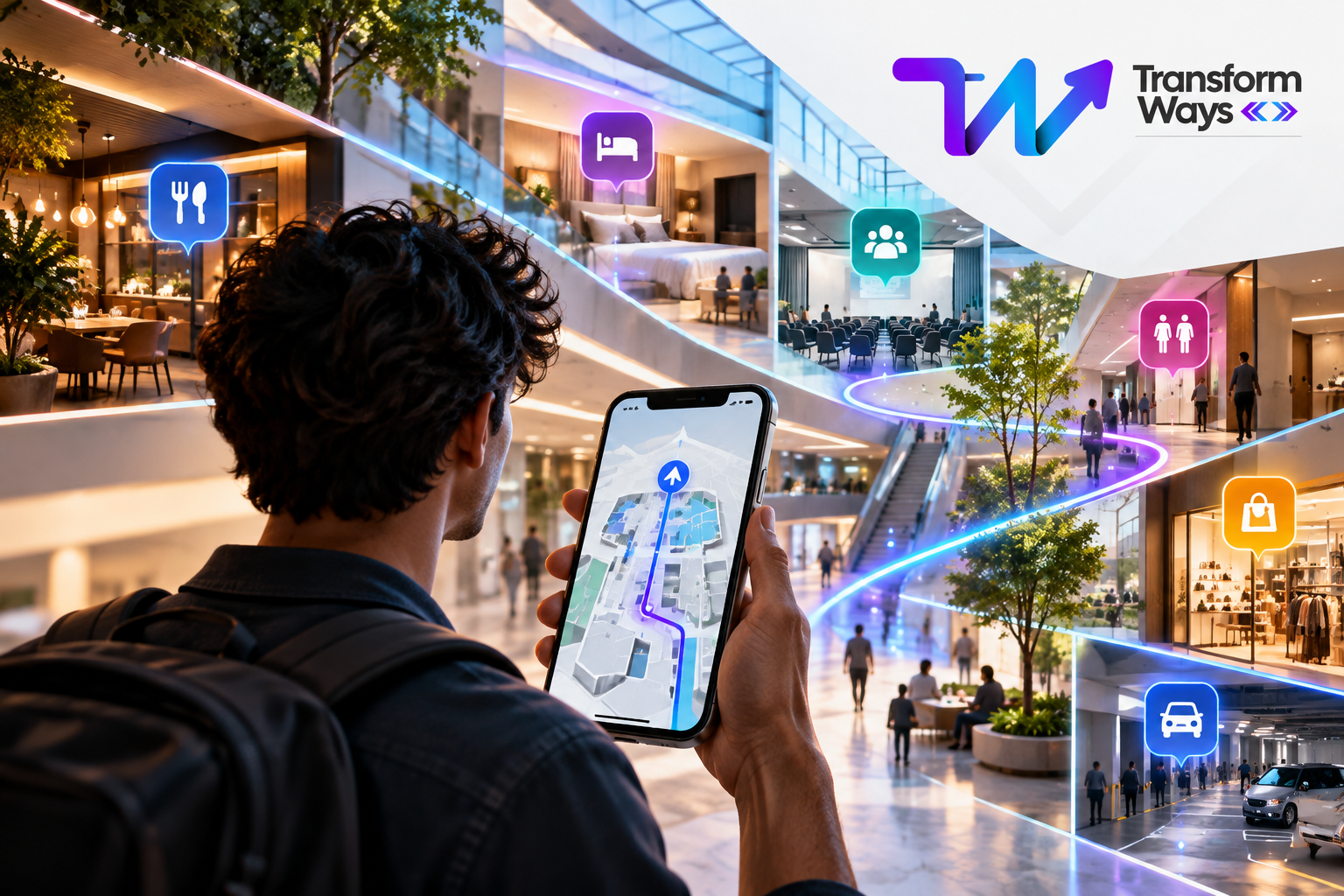
How Digital Wayfinding Helps Guests Discover Amenities in a Venue
You walk into a place you’ve never been before.
The first thing you usually want to know is simple: Where do I go?
Maybe you’re looking for a meeting room. Maybe it’s a restaurant, restroom, parking area, reception desk, or a particular shop. You look around for a sign. Then another one. Sometimes you find what you’re looking for quickly. Sometimes you end up walking in the wrong direction and have to turn around.
And then there is another problem that is easy to miss.
You may never discover what else the place has to offer.
A café could be just around the corner. There might be another entrance closer to where you’re going. A visitor lounge could be on the next floor. An exhibition, activity area, or useful facility might be only a few minutes away.
But if you don’t know it is there, you probably won’t look for it.
This is one of the everyday problems that digital wayfinding can solve.
It is not simply about showing people where to go. It can help them understand a place, find what they need, and discover things they might otherwise walk past.
Why Finding Your Way Is Sometimes Harder Than It Should Be
Most venues already have signs.
So why do people still get lost?
Because a sign usually answers only one question.
“Which way is this?”
It doesn’t always answer:
- What is nearby?
- Is there another route?
- What facilities are available here?
- How far away is it?
- What else can I find on the way?
- Where should I go after this?
This becomes more noticeable in larger places.
Think about an airport, hospital, university campus, shopping centre, convention centre, museum, corporate campus, hotel, or resort. There can be several buildings, floors, entrances, corridors, facilities, and points of interest.
A visitor who has never been there has no mental map of the place.
They are trying to build one while walking.
That’s where things can become frustrating.
A Map Can Do More Than Show You the Way
Most people think of a map as something that helps them reach a destination.
But an interactive map can be much more useful than that.
Let’s say you’re visiting a large event venue.
You open the map because you need to find Hall B.
You find it.
But while looking at the map, you also notice a café nearby, a restroom close to the hall, another event taking place in Hall C, and an exit that may be more convenient for you.
You didn’t search for those things.
You discovered them because the information was there when you needed it.
That’s an important difference.
Good digital wayfinding doesn’t only answer “Where is it?”
It can also answer “What else is around me?”
Helping People Discover Amenities They Didn’t Know About
A venue may have dozens of useful facilities, but visitors don’t necessarily know all of them.
A university may have several student facilities that new students haven’t discovered yet.
A hospital may have a pharmacy, café, parking area, or waiting facility that a visitor doesn’t know about.
A shopping centre may have restaurants and services tucked away on different floors.
An exhibition centre may have multiple halls, lounges, food areas, and visitor services.
A hotel may have several facilities that a guest simply hasn’t heard about.
This is where the phrase “discover amenities in a venue” becomes more meaningful.
The goal isn’t to show people a long list of facilities.
It is to make those facilities easier to notice and find when they are relevant.
Instead of asking someone, “Is there a café nearby?”, a visitor could simply explore the map and see what is around them.
That small change can make a place feel much easier to use.
Digital Wayfinding Gives People More Control
Not everyone navigates a place in the same way.
One person may want the fastest route.
Another may prefer the nearest entrance.
Someone else may be looking for an accessible route.
A family might be interested in restrooms and dining areas.
A conference attendee may only care about meeting rooms.
Visitors have different priorities.
A digital wayfinding experience gives them the freedom to explore based on what they need.
They don’t have to follow one fixed path.
They can search.
They can browse.
They can look around.
They can decide where they want to go next.
That makes navigation feel less like following instructions and more like exploring a place on their own terms.
What About Traditional Signs?
Traditional signs aren’t going away.
And they shouldn’t.
Physical signs are still extremely useful. They work when someone is walking through a building, driving toward an entrance, or looking for a particular floor.
The problem comes when signs are expected to do everything.
A sign can point you toward a restaurant.
It cannot easily show you every other restaurant, café, restroom, event, service, or facility around you.
That’s where digital and physical wayfinding can work together.
The sign helps you notice where to go.
The digital experience helps you explore the bigger picture.
It’s not about replacing one with the other.
It’s about making navigation easier from different points of the visitor’s journey.
QR Codes Make Access Simple
One reason digital wayfinding has become practical for venues is that people already carry the device they need.
Their phone.
A QR code can be placed at an entrance, reception desk, information counter, event area, parking zone, guest room, or other useful location.
A visitor scans it and opens the digital map.
That’s it.
They don’t necessarily need to search through a website or download a separate application just to find a location.
This can be particularly useful for places where visitors are constantly changing.
An exhibition may have thousands of visitors over a few days.
An airport has passengers arriving and leaving throughout the day.
A university welcomes new students and visitors every year.
A hospital sees people who may be visiting for the first time.
Making navigation easy to access matters.
It Can Also Make Staff’s Jobs Easier
Ask someone working at a large venue how many times they hear the same questions.
“Where is the restroom?”
“Which way is the main hall?”
“Where can I park?”
“Where is the café?”
“Which floor is this department on?”
These questions are normal.
Visitors don’t know the building, so they ask.
But answering the same basic directions again and again takes time.
A digital wayfinding system can handle some of those simple questions.
That doesn’t mean staff become less important.
Quite the opposite.
Staff can spend more time helping visitors with things that actually need human attention—special requests, recommendations, accessibility support, problems, or personal assistance.
Technology handles the simple part.
People handle the human part.
The Real Value Is Confidence
There is another benefit of good wayfinding that isn’t always discussed.
Confidence.
When people know where they are and where they are going, they feel more comfortable exploring.
They don’t have to keep checking signs.
They don’t have to worry about taking the wrong corridor.
They don’t have to stop someone every few minutes to ask for directions.
They can simply move.
That matters because navigation is part of the overall experience of a place.
A beautiful venue can feel confusing if it is difficult to understand.
A large venue can feel surprisingly simple when the information is presented well.
The physical space hasn’t changed.
The visitor’s experience of it has.
Digital Wayfinding Can Work Almost Anywhere
There isn’t one specific industry that owns digital wayfinding.
The same idea can be useful in many different places.
Airports
Passengers can find gates, lounges, restaurants, restrooms, baggage areas, and other services.
Hospitals
Patients and visitors can locate departments, clinics, pharmacies, waiting areas, entrances, and elevators.
Universities
Students and visitors can find classrooms, departments, libraries, sports facilities, and administrative offices.
Shopping Centres
Shoppers can discover stores, restaurants, entertainment areas, parking, and other services.
Convention Centres
Visitors can find halls, meeting rooms, registration counters, exhibitors, food areas, and exits.
Museums and Attractions
Visitors can explore galleries, exhibitions, cafés, restrooms, and other points of interest.
Corporate Campuses
Employees and visitors can find buildings, meeting rooms, reception areas, parking, and shared facilities.
Hotels and Resorts
Guests can discover restaurants, pools, wellness facilities, event spaces, activity areas, and other amenities.
The setting changes, but the basic need doesn’t:
People want to know where they are, where they need to go, and what they can find along the way.
What Makes a Digital Wayfinding Experience Good?
A digital map doesn’t automatically make navigation better.
If it is confusing, slow, outdated, or overloaded with information, it can create another problem.
A useful experience should feel simple.
People should be able to open it and understand what they are seeing without reading a manual.
It should also work well on mobile devices, because that’s where most visitors are likely to use it.
The information needs to be accurate too.
If a restaurant has moved to another floor but the digital map still shows the old location, the technology has failed at the most basic level.
The best systems focus on practical questions:
Where am I?
Where do I want to go?
What is nearby?
What else might be useful to me?
That’s really what good wayfinding is about.
Where Transformways Fits In
Transformways looks at wayfinding from the perspective of the person actually using the space.
A venue is more than its buildings and facilities. It is a place people need to understand, move through, and experience.
Transformways helps turn physical spaces into interactive digital experiences where visitors can explore locations, find amenities, understand the layout, and navigate more confidently.
The idea isn’t to make people stare at a map all day.
It’s to give them useful information at the moment they need it.
Someone should be able to enter an unfamiliar venue, open the experience, find what they need, and then get on with their day.
That’s the point.
Frequently Asked Questions
What is digital wayfinding?
Digital wayfinding uses digital maps and location-based information to help people navigate physical spaces. It can help visitors find destinations, explore nearby facilities, and understand the layout of a venue.
How does digital wayfinding help visitors discover amenities in a venue?
It makes facilities easier to see and search for. Visitors can explore categories or look at nearby points of interest instead of relying only on signs or asking staff.
Does digital wayfinding replace physical signs?
No. Physical signs remain useful. Digital wayfinding can work alongside them and provide additional information that signs cannot easily display.
Can digital wayfinding work without an app?
Yes. A web-based experience can be accessed through a smartphone, including through QR codes placed around the venue.
What types of venues can use digital wayfinding?
Airports, hospitals, universities, shopping centres, hotels, resorts, museums, exhibition centres, corporate campuses, event venues, and many other spaces can use digital wayfinding.
Can digital wayfinding help reduce repetitive questions for staff?
Yes. Visitors can use the digital experience to answer straightforward location questions themselves, allowing staff to focus on more personal or complex requests.
Why is discovering amenities important?
A facility can only be useful to visitors if they know it exists and can find it. Making amenities easier to discover can help visitors make better use of the venue.
Make Your Space Easier to Explore
People shouldn’t have to work hard to understand a place.
Whether they’re visiting an airport, hospital, campus, shopping centre, exhibition, hotel, office, or another unfamiliar venue, they should be able to find what they need without unnecessary confusion.
That’s where digital wayfinding can make a difference.
Transformways helps turn physical spaces into interactive digital experiences that make navigation and discovery simpler.
If your venue has more to offer than visitors currently discover, it may be time to make those experiences easier to find.
Explore Transformways and see how your space can become easier to navigate, easier to understand, and easier to explore.